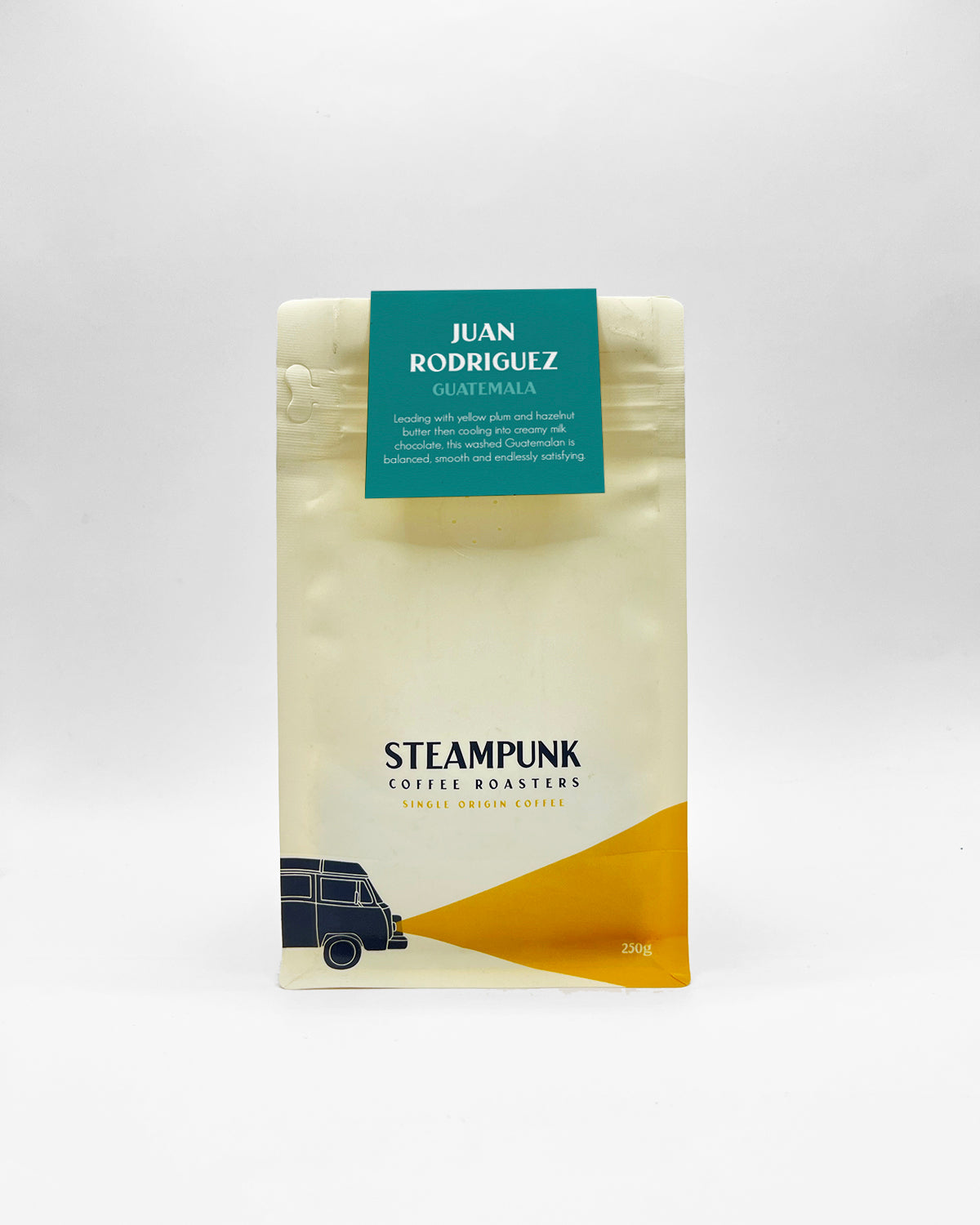


GUATEMALA JUAN RODRIGUEZ
GUATEMALA JUAN RODRIGUEZ
Recommended Retail Price: £12.50/250g
Tasting Notes: Leading with yellow plum and hazelnut butter then cooling into creamy milk chocolate, this washed Guatemalan is balanced, smooth and endlessly satisfying.
Region: Huehuetenango
Altitude: 1700-1800 masl
Variety: Caturra, Bourbon, Catimor
Processing: Washed
UK Arrival: June 2026
This washed Guatemalan lot is one of the most balanced, easy-drinking coffees we’ve tried all year. It comes to us through Primavera, an importer founded in Guatemala which works hard to promote sustainability and improve quality at origin. Having sourced through Primavera before, we’re excited to be working with them for the second time and showcasing the depth of coffee that Guatemala has to offer.
Juan Rodriguez takes great care over his farm, Wiwitz, and is involved at every step of his coffee’s journey. Juan and his wife learned how to sow coffee from their parents. From building their own nursery to the final processing and drying. Their meticulous work has led to a delicious cup that we are so excited to share.
Juan Rodriguez
Juan and his wife learned how to grow coffee from their parents. They bought their farm and built everything from the ground up. After buying land, they created a nursery to grow seedlings then they planted the seedlings on their small 1.1 hectare farmland.
This lot of their coffee is depulped the same day it is picked, and then it is fermented in fresh water for about 24-32 hours. He also does a second soaking in water for 12 hours before setting the coffee to dry on a patio. The coffee sun dries on the patio for 3 days and is turned regularly to ensure even drying. Juan himself is in charge of the processing.
Juan chose to grow coffee as it was the best crop to earn an annual income. He works hard on the farm, doing much of the weeding, pruning, and applying compost himself. They also hire local laborers when needed.
Primavera Green Coffee
This coffee was brought to us by Primavera Green Coffee, an importer with strong roots in Guatemala. The founder, Nadine Rasch, comes from four generations of coffee farmers there. We’ve been cupping their coffees for a few years now and have been consistently impressed by the quality coffee they’re importing. We’re excited to work with them for a second time.
Primavera also has released a sustainability report annually for the past 5 years. Focusing on their commitment to economic, social and environmental sustainability, what work they do along the supply chain to achieve their goals and also how they plan to keep these practices going in the future. They host workshops for farmers to learn about various ways to ensure economic sustainability, explaining topics such as Waste Management, Post-Harvest Processing and Costs of Production. They also host Agronomy programs to help farmers look after their farms and local environments, they teach how to make organic worm compost, fight soil erosion and conserve native forests. Then by working with young producers they support the social sustainability of their communities. Many men travel to work abroad to earn more money and support their families. Primavera helps the producers make more money on their coffee and in the long run this will mean they won't have to travel abroad as much. They also focus heavily on helping women producers have more equity in the coffee market. Giving them more access to credit, training and fundamental education, which in turn empowers them to make better decisions with their business.
Primavera says, “Despite the challenges, this year’s quality has been excellent. This is in large part due to the hard work of our team in Huehuetenango, whose work with producers ensures they selectively pick and process as carefully as always.” These market challenges were compounded by a late harvest. Primavera reports that chilly nights in November and December resulted in slower maturation for the cherries and a delay in the harvest of about three to four weeks. Given that, it was likely even harder to convince farmers to let their cherries ripen fully before picking. But slower ripening also means sweeter fruit and therefore sweeter coffee.
Coffee in Guatemala
The history of coffee in Guatemala follows familiar lines of colonial introduction, post-independence land reform and indigenous disenfranchisement. The impacts of this colonial history were compounded by agricultural exploitation by the United States in the early part of the 20th century, which culminated in a US-backed political coup in 1954. Over 30 years of civil war followed the coup, with repeating cycles of violence and repression. “Many of the issues that provoked the war—poverty, land distribution, hunger and racism toward indigenous people—are still issues today,” according to James Hoffmann in his World Coffee Atlas.
Coffee has been a cornerstone of the Guatemalan economy since the late 1800s. In 1880 it made up about 80 percent of the county’s exports. The industry took a massive hit in the early 2000s when prices stagnated below the cost of production and coffee leaf rust swept through Central America decimating entire harvests. Today, Guatemala is the 4th largest Arabica exporter worldwide, according to USDA data.
Share