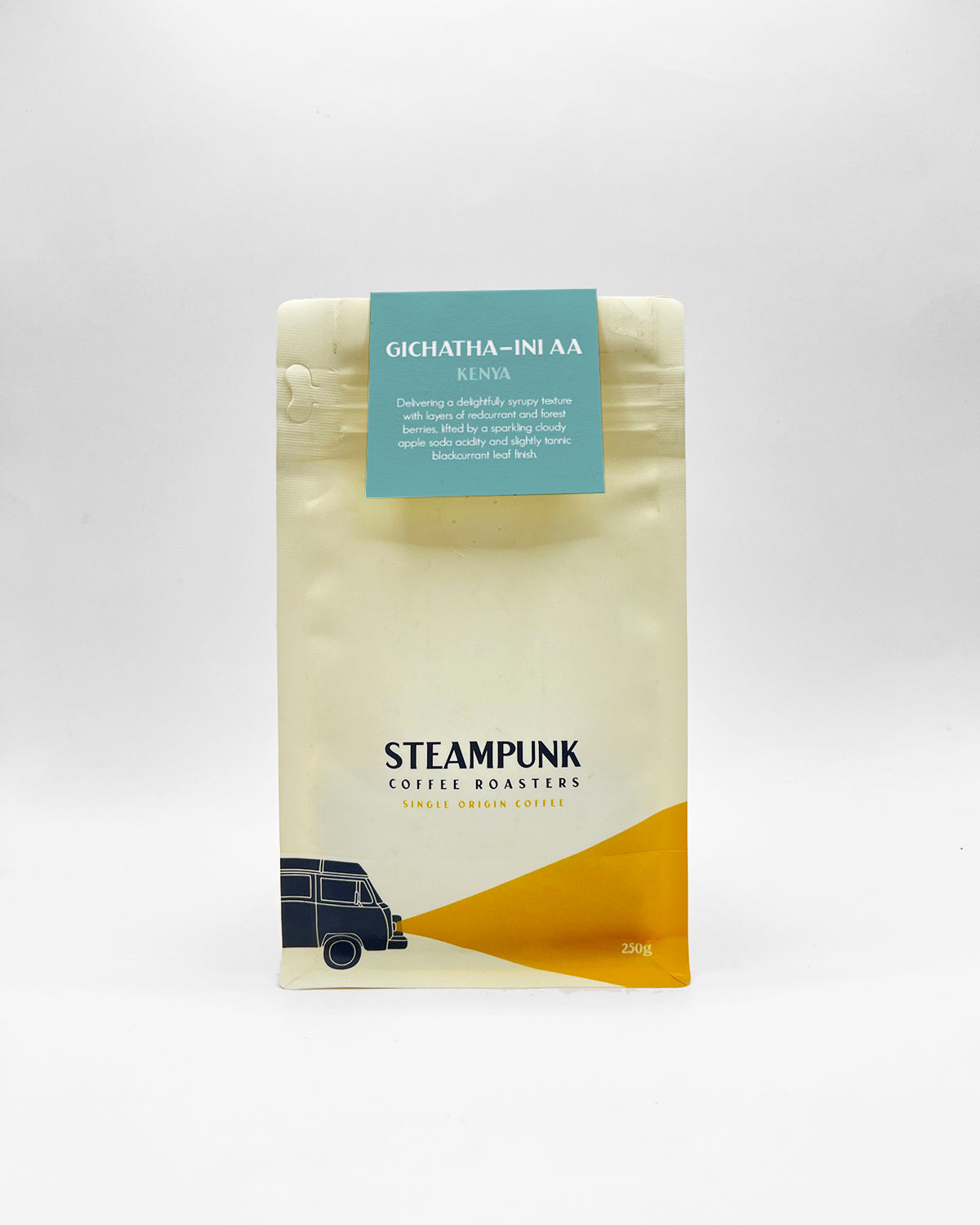


KENYA GICHATHA-ini AA
KENYA GICHATHA-ini AA
Recommended Retail Price: £15/250g
Tasting Notes: Delivering a delightfully syrupy texture with layers of redcurrant and forest berries, lifted by a cloudy apple soda acidity and slightly tannic blackcurrant leaf finish.
Region: Nyeri
Altitude: 1700-1800 masl
Variety: SL34, SL28
Processing: Fully Washed
UK Arrival: July 2026
Established in 1968, shortly after Kenya’s independence, the Gichatha-ini Washing Station has deep historical roots. The name originates from the colonial era when locals were organized into villages called Gichagi. The washing station is located in Nyeri County and processes cherries from farms situated between 1,700 and 1,800 masl. Nestled between the southern slopes of Mt. Kenya and the foothills of the Aberdare Range, the rich volcanic soil is full of nutrients and the high elevation ensures a cool climate that is a steady 13 to 24 degrees Celsius. The lower temperature slows cherry maturation, allowing the tree to push more of these nutrients into the cherries, developing a higher concentration of sugars in the fruit and leading to a more complex flavor profile. Farmers primarily grow traditional SL varieties, which are world renowned for their superior cup quality and vibrant acidity. SL28 and SL34 are staples of Kenyan coffee and a large reason why this origin is a favourite for many people.
SL28 & SL34
SL28 and SL34 were first developed by the Scotts Agricultural Laboratories back in the 1930’s during the British Colonial rule as they were trying to cultivate a hardy hybrid that would suit the climate of Kenya while still providing a substantial yield to Kenyan farmers. Individual tree selections made at the Scott Laboratories during the 1935-1939 period were given the prefix SL and in total forty two trees of various origins were selected and studied for yield, quality, drought and disease resistance.
SL28 is prized for its deep sweetness and purple fruit flavours, while also meeting those drought resistant requirements. SL34 delivers a bright acidity and more full bodied cup along with a slightly higher yield and similar sturdiness.
These cultivars are far from perfect however, as they are susceptible to coffee plant diseases such as leaf rust, coffee berry disease and nematodes. This is why alongside SL28 and SL34 many farmers in Kenya have chosen to plant Ruiru 11 and Batian varieties as they are much more disease resistant. While this ensures more consistent yields and stability in income year on year they sadly do not deliver the same exceptional cup quality.
Kenyan Coffee
The way coffee is traded in Kenya has changed a lot in the last few years, making things more complicated for exporters and their importer partners. Previously, exporters could buy coffee through auctions or negotiate prices with cooperatives via marketing agents. However, this system changed in 2023, when new regulations were put into place. Marketing agents have been replaced by brokers who require specific licences to operate. Exporters now must wait for coffee to enter auctions before acquiring samples and making purchases. This means they can no longer buy directly from cooperatives or access early samples as before. The milling process, which takes place after the coffee is dried but before it is exported, has also changed. The majority of mills are now government owned. This new legislation was intended to prevent a concentration of sales under multinational entities.
The auction system in Kenya remains very transparent, with coffees clearly separated into small lots and different grades. Farmers know exactly what portion of the sales price goes back to the cooperative society after processing costs. Some cooperative societies and factories are able to pay back up to 90% of the sales price after deducting marketing and preparation costs.
Cofinet
Cofinet was founded in 2015 in Sydney, Australia by Carlos and Felipe Arcila who are fourth-generation Colombian coffee growers with a clear and inspiring mission: to share the finest Colombian coffee with the world. But their vision extended far beyond simply delivering exceptional coffee - they aim to build a bridge which connects farmers with roasters and coffee lovers across the globe.
Now they export coffee not just from Colombia but also Brazil, Ethiopia, Peru and Kenya. They also prioritise sustainability through the relationships they build with farmers, producers and roasters by offering support and development at every stage of the supply chain. Through courses on agroforestry, water conservation, producer internships and coffee education they aim to improve not just the quality of their coffee but also long lasting direct relationships.
We have been buying Colombian coffee from Cofinet for many years, even a delicious Papayo from Carlos and Filipes father Jairo Arcila, and now we are excited to share this beautiful washed Kenyan lot.
Share